


Fewer Matters, Fully Attended.
The Dharpana Chambers is devoted to contested litigation and considered counsel before the High Courts and the Supreme Court of India. The docket is kept deliberately small, and every matter is conducted in confidence.
Three words on the seal. One standard for every brief.
Proficiency
Command of the law, the record, and the forum, through thorough preparation.
Integrity
Candid counsel, held in confidence, given in the client's interest alone.
Excellence
A single standard, from the first note to the final submission.
One practice, undivided.
Organisation
The Dharpana Chambers is organised around a single discipline, contested litigation, rather than around subject headings. That is deliberate, because disputes do not respect departmental lines. A single matter may travel from a trial court to a writ court to the Supreme Court of India, raising questions of contract, constitution, procedure, and evidence in the same breath.
Forums
Before the High Courts and the Supreme Court of India, the Chambers appears across the constitutional spectrum, in writ proceedings, appeals, revisions, and the other jurisdictions those Courts exercise. At the trial stage, the work of the Chambers is confined to the defence.
Advisory
Alongside litigation, the Chambers offers advisory and consultation on matters where a dispute has not yet arisen. Much of this work is done early, in examining the record, addressing gaps in a position, and considering the ground on which any future contest would be conducted.
Subject Matter
The Chambers is not confined to any field of law. It appears in commercial, constitutional, criminal, property, and family matters alike. The criterion is not the subject but the dispute: a matter is undertaken where the question is substantive and genuinely contested. Counsel's earlier career in engineering informs the method the Chambers brings to any subject, an approach built on examining how a position may fail before it is advanced.
The basis on which the Chambers accepts work.
The following sets out the basis on which the Chambers accepts work. It is stated so that a prospective client understands, before any Legal Consultation, the terms on which a matter is undertaken.
A Deliberately Limited Docket
The Chambers accepts only a small number of matters at any given time. This is a settled policy of the practice, not a reflection of demand. It follows that the Chambers may, by reason of existing commitments alone, be unable to accept a new matter, and will say so at the outset. Each matter that is accepted receives sustained and undivided attention.
Stakes as the Threshold
The Chambers confines its practice to contested litigation involving substantial questions. Routine, uncontested, or formulaic briefs are respectfully declined.
Jurisdictional Scope
At the trial stage, the Chambers accepts briefs strictly for the defence. Before the High Courts and the Supreme Court of India, the Chambers appears across appellate, revisional, writ, and the other jurisdictions those Courts exercise.
Discretion in All Things
Every engagement is conducted in confidence. The identity of clients, the substance of instructions, and the course of a matter remain within the Chambers alone.
Intake Prerequisites
The Chambers accepts a brief only where the client is prepared for the rigours of the litigation and is committed to proceeding to its conclusion with complete instructions and candour.
No Subject-Matter Confines
The Chambers is not organised by field of law. A matter is accepted only where the Chambers is satisfied that it can properly undertake the subject the matter involves, and is otherwise declined.
Advocate Ganesh K.
Founder
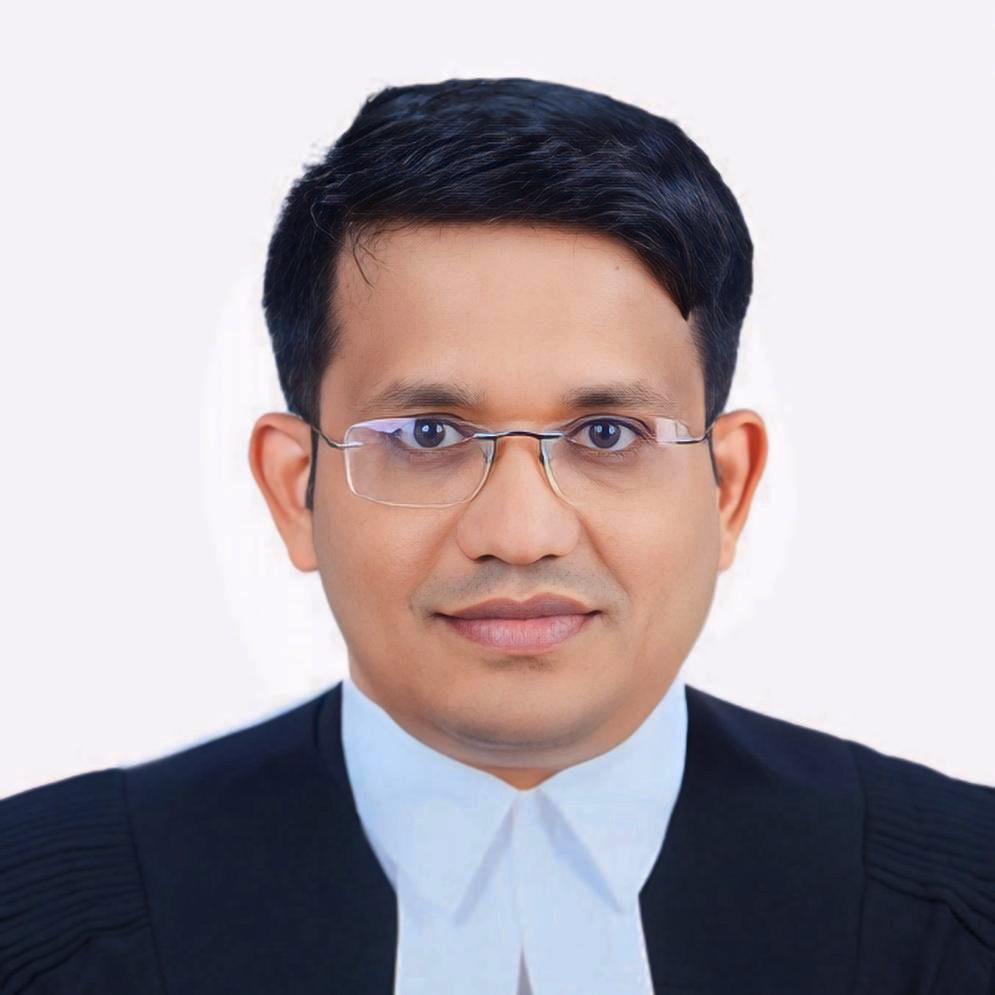
- LL.B.First Rank and Gold Medallist, Karnataka State Law University, Hubli, in a university comprising 173 law colleges
- M.S., Software EngineeringBirla Institute of Technology & Science (BITS), Pilani
- Prior CareerSoftware Architect, Ex-Oracle, Ex-Salesforce
- FoundationTheoretical mathematics, applied computing, and law
- PracticeRegular appearances before the High Courts. Has appeared before the Supreme Court of India
An advocate whose practice is built on preparation and a problem-solver's discipline. He appears regularly before the High Courts and has appeared before the Supreme Court of India, and he completed his LL.B. as First Rank and Gold Medallist at Karnataka State Law University, Hubli, a university of one hundred and seventy-three law colleges. He holds an M.S. in Software Engineering from BITS Pilani. His drafting is done personally, and a client deals with him directly at every stage of a matter.
What distinguishes his approach is where it came from. Before the law, he spent thirteen years solving hard technical problems at scale, and he reasons through a legal dispute the same way he once reasoned through a complex system: patiently, from first principles, pressing on a position until he knows precisely where it holds and where it gives. It is an unusual temperament to bring to the Bar, and it is the one clients tend to remember.
His foundation is in theoretical mathematics and applied computing. Prior to the law, he held senior positions across the technology industry in California: Practice Head at Uptima, Principal Consultant at Oracle Corporation, Advisory Consultant at Salesforce, and Software Architect at a blockchain venture. He left that career deliberately, for work he found more consequential.
Center for Law and Technology Research
The law is not a fixed body of rules to be learned once and thereafter applied. It is an intellectual discipline in continuous motion, answering to the society it governs, to the pressures of geopolitics, and above all to technology, which has altered not merely the subjects of litigation but the terms on which disputes are now framed and decided. What was settled a decade ago is unsettled today. What is contested today will be resolved by arguments not yet made. To practise in such conditions is to accept that command of the law is never a possession but a pursuit, and that the pursuit cannot begin when the dispute does.
The Dharpana Chambers understands this to its core. The Center for Law and Technology Research is the institutional form of that understanding, a standing wing in which the law is studied from first principles, tested against the technology that now presses upon it, and followed across the whole of the litigation and advisory landscape. Its foundation is the counsel's own, drawn from years spent architecting the systems the law is only beginning to comprehend. Because the docket is deliberately limited and the drafting done by hand, what is learned in the Center reaches the pleadings directly.
Counsel cannot advise honestly upon a landscape they have not troubled to learn. The Center exists because that obligation is owed in every matter the Chambers accepts, whatever its field.
How to reach the Chambers.
No. 997, First Floor, Nandi Grand,
12th A Cross, 35th Main,
J.P. Nagar 1st Phase,
Bengaluru 560
078
+91 91553 55350Legal Consultations by appointment